Ikebana
A flower in a vase is decoration. An ikebana is a statement about the plant it is made from.
How I understand it
In a bouquet the individual plant disappears. The more blooms there are, the fuller it looks, and none of them has to do anything in particular. In ikebana the opposite holds: the less material there is, the more precisely each single flower has to sit.
So the work begins with looking. A branch grew in one direction because the light was there. A leaf is paler on one side. A flower faces somewhere. All of this is present before anything is cut, and an arrangement that takes up these particularities looks different from one that overrides them.
Nor does ikebana show only the flowering. A bud carries its future within it, a withered leaf the life it has lived. Both belong.
Ikenobō
Ikenobō is the oldest school of ikebana. Its seat is the Rokkakudō in Kyoto, formally Shiunzan Chōhōji, a temple said to have been founded by Prince Shōtoku. Ono no Imoko, a Japanese envoy to the court of the Chinese Sui dynasty, is named as its first head priest. Since then the heads of the school have held that office.
The name comes from the priests' quarters beside the temple pond: ike is the pond, bō the lodging. Those who lived there brought the flowers to the altar morning and evening. During the Muromachi period, between the fourteenth and the sixteenth century, that offering grew into an art for interiors. Ikenobō Sen'no established its principles at that time. Around 1450 Senkei Ikenobō founded the first ikebana school proper at the Rokkakudō.
Today it is led in the forty-fifth generation by Ikenobō Sen'ei.
The styles
Tatehana
The earliest form, from which everything else came. The word means upright form, from tateru, to stand, and hana, flowers. Tatehana is the early art of offering flowers before the Buddhist deities.
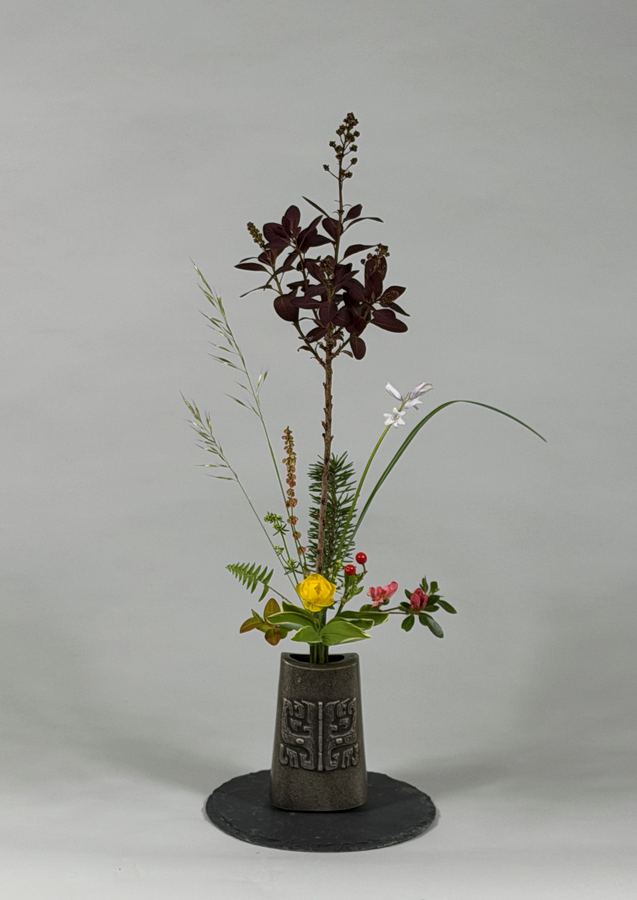
Rikka
The second oldest form, which grew out of Tatehana during the Muromachi period. A Rikka portrays a whole landscape rather than a single plant. It rests on seven or nine main lines, the yakueda.
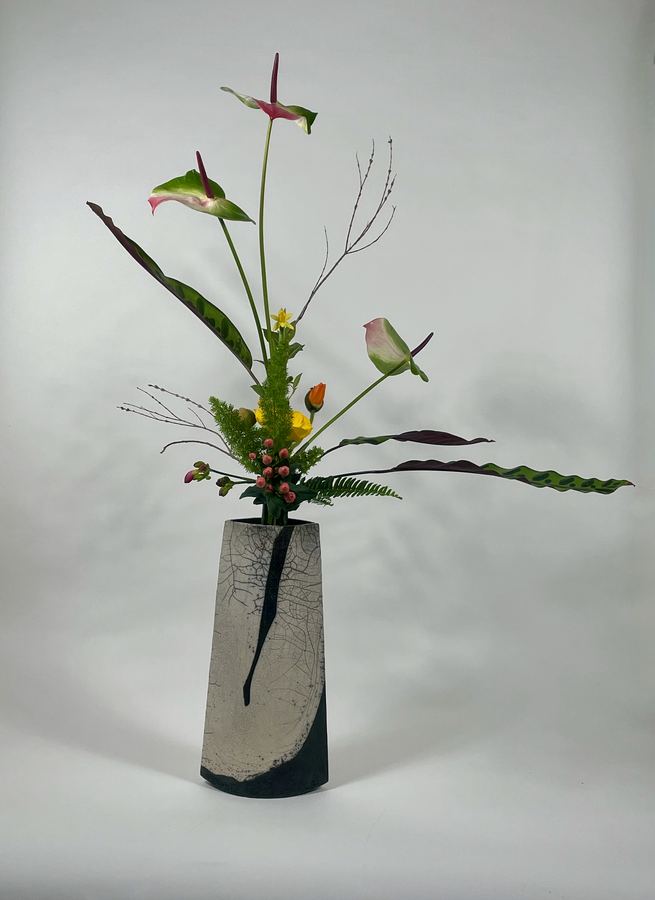
Shōka
Formalised in the late Edo period, using no more than three kinds of plant material. A Shōka puts the emphasis on naturalness and on the character of the plants used. It rests on three main lines named shin, soe and tai.
The mizugiwa matters particularly here: the point at which the plants leave the water. It should be slender, clean and straight, so that all the stems appear to rise from a single root.
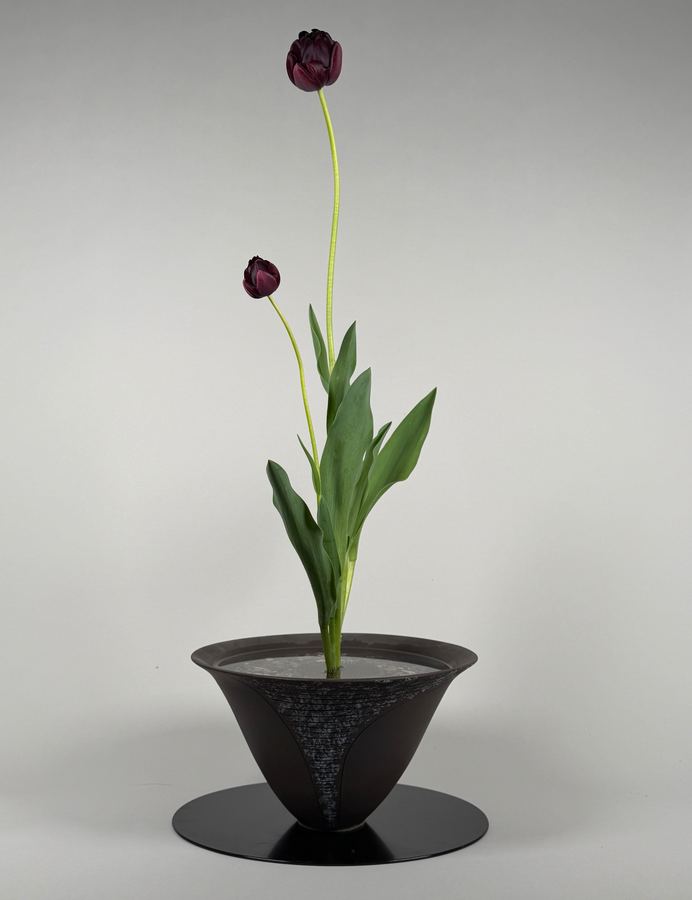
Jiyūka
The free form, with no fixed structure and no restriction on material. Here the intention behind the work and its execution are what count.
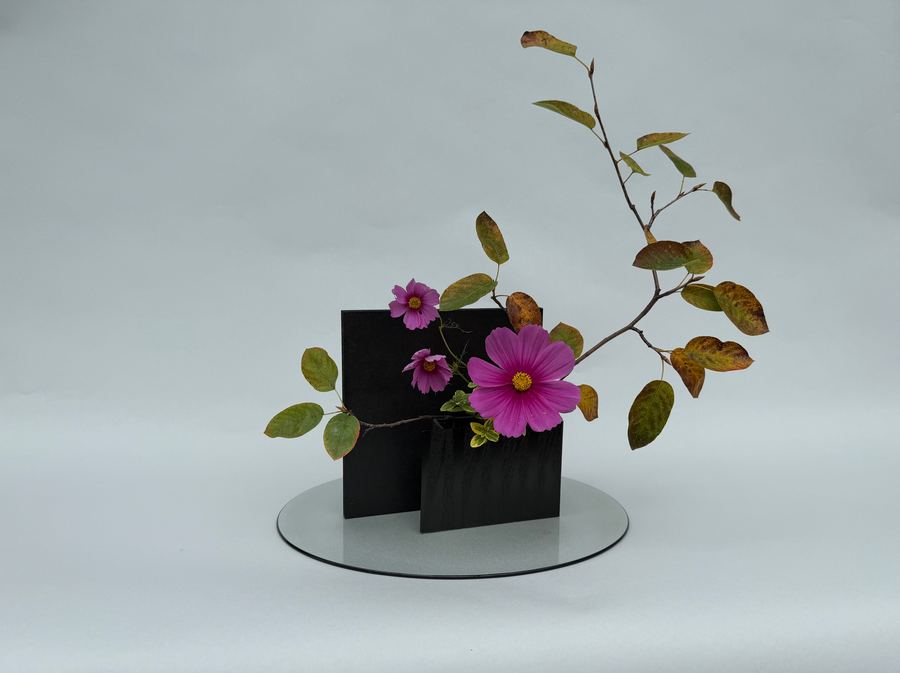
Shōfutai and shimputai
Rikka and Shōka each come in two versions. Shōfutai follows the traditional form, shimputai has no fixed form. Both were introduced by the present head of the school, Sen'ei Ikenobō: Shōka Shimputai in 1977 and Rikka Shimputai in 1999.
What I teach
Shōka and Jiyūka. What that involves is set out on the lessons page.